
Welcome to the End of the World
Mind the Speed Bumps

This is the first dispatch from Joyriding the Apocalypse—a weekly-ish newsletter about life lived on the margins of a crumbling empire. I’ve been sleeping in my car for a decade. Here’s why I’m writing now.
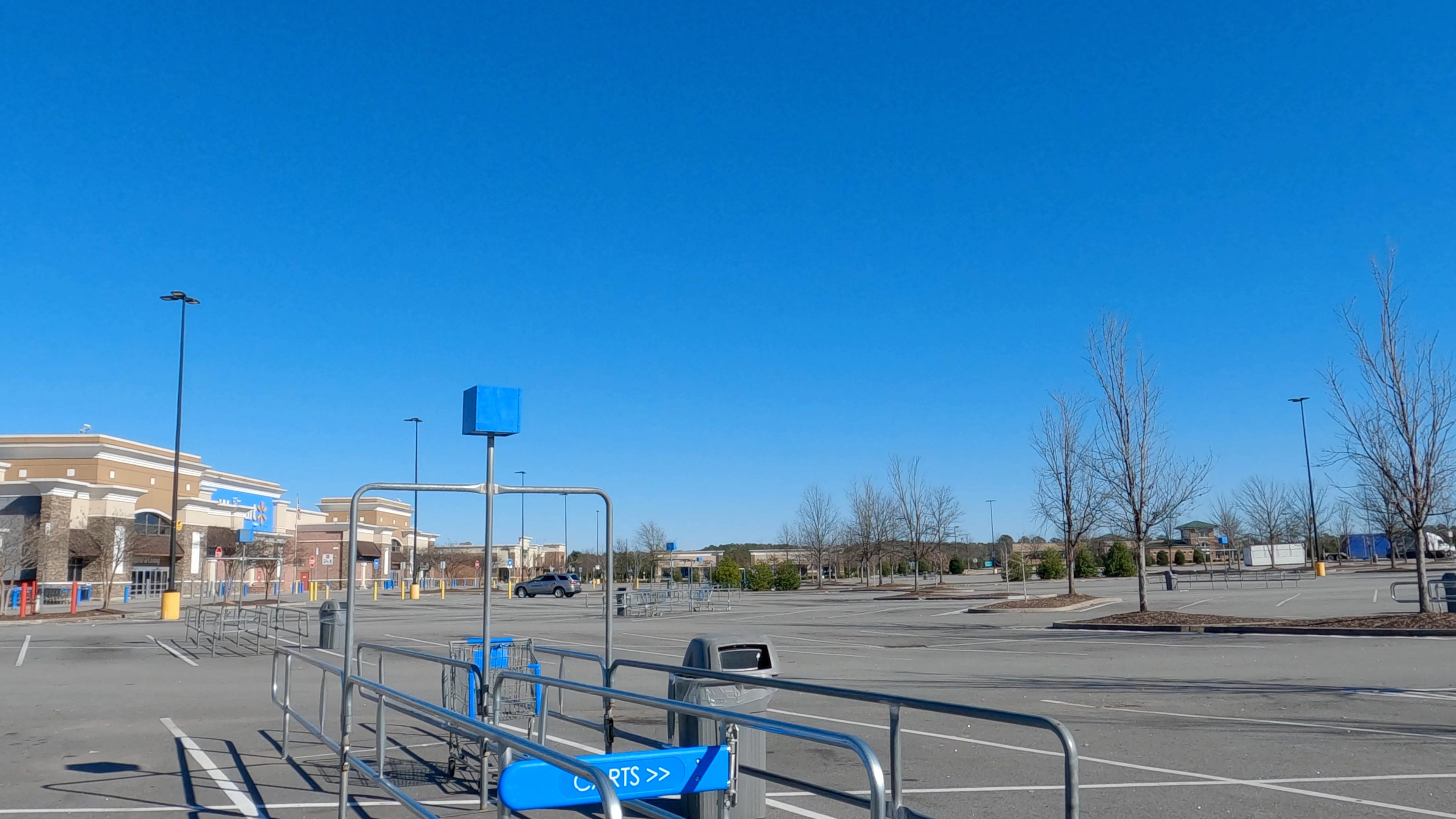
Walmart parking lot, Grovetown, Georgia. One of a thousand nearly identical places where people sleep, survive, and try to stay invisible.
The Parking Lot at the End of the World
It’s 2 AM at the edge of a Walmart parking lot. The overhead lights buzz like dying insects, casting long shadows across the asphalt. A row of RVs sits like a makeshift village stitched together out of fiberglass and faded decals. Somewhere in the distance, a sedan rattles low with its engine still running—maybe for warmth, maybe out of habit, maybe to keep the battery from dying one more time.
There’s a shopping cart in the wind, moving slow and aimless. Someone outside leans back against the hood of their car, smoking, watching, but not really seeing. We’re all just background to each other out here.
This is the new commons, the last shared space in a privatized nation. Not a town square. Not a public park. Just a slab of pavement no one cares enough to fence off—except when they do. Here, you can sleep, but not too long. Stay, but not belong. You’re tolerated as long as you remain invisible. As long as you look like you’re just passing through.
But this is my roost. Has been, off and on (mostly on), for the last decade. Living in a car isn’t just about surviving—it’s about watching the empire from the margins, bearing witness while everyone else pretends the center still holds. You learn a lot when you’re not supposed to be anywhere. You start to see things that were always there, hidden in plain view.
People think of car-dwelling as failure. But sometimes it’s success. Sometimes it’s a victory, compared to what went before.
Why This Substack? Why Now?
Ten years. That’s how long I’ve been living in and out of my car. Long enough to watch seasons change through a chipped windshield. Long enough to have lived in the gutters of 47 states. Long enough to know which places have showers where my trans body is safest and which places hire security guards for that 3AM window knock. Long enough to see the myths pile up—about freedom, about laziness, about choice—and long enough to watch those myths crack under the weight of reality.
I’ve seen the rise of #vanlife influencers, the filtered photos of open roads and minimalist interiors staged with throw pillows and fairy lights. I’ve read the blogs that talk about downsizing and self-discovery. But that’s not what this is. I’m not living out a curated lifestyle brand. I’m not selling a dream. I’m surviving a system that was never designed for me to exist, let alone win.
Some of us chose this. Some of us had no choice. Some of us stayed after the first crisis passed, because we learned something essential out here. And some of us are just trying to hold it together until we can find something—anything—more stable. Most of us aren’t trying to make a statement. We’re just trying to keep breathing.
So this Substack is a few things at once:
A memoir. A survival guide. A witness account. A love letter to the liminal spaces.
It’s for anyone who’s ever wondered what this life is really like—and for the ones already living it, who might want to know they’re not alone.
Aspirationally weekly. Occasionally feral. Always honest.
A transmission from the parking lot nation.
Who This Is For
This is for the curious—the ones who’ve stared out their apartment window and wondered what it might be like to live in a car. Not the fantasy version, not the YouTube-ready #vanlife dream, but the real thing. The cold mornings. The sweltering afternoons. The parking lot rituals. The strange, quiet freedom that grows as what-you-have-left-to-lose shrinks.
It’s for the unhoused and fellow car-dwellers. You already know how to survive. You’ve learned how to read a neighborhood and figured out which big box stores allow overnight stays without hassle. Maybe you’ll find some new tips here. Maybe just a little solidarity.
It’s for the radicals—the ones who’ve seen the cracks in the foundation, who know that rent is a racket and the myth of upward mobility was never designed to hold the majority of us. You already understand that this isn’t about individual failure. It’s about structural rot.
And it’s for the soon-to-be-here. The ones in free fall, watching the asphalt rise to meet them. The ones watching their savings dry up, their rent spike, their safety net fray thread by thread. The ones who think this could never be them—until it is.
If you don’t fit into any of those groups, stick around anyway. The end of the world doesn’t care what zip code you came from. Everyone’s welcome in the parking lot. At least until that big knock in the small hours signals it’s time to move on.
Myths vs. Reality: What Living in a Car Actually Means
🚫 It’s not a vacation.
The Instagram version is a lie.
All those filtered sunsets and rooftop tents don’t show the nights you wake up to pee, shivering. You break the ice on the cat’s water bowl. You run the heater for twenty minutes just to soften the cold before slipping back to sleep.
They don’t show the way the inside of your windows drip with condensation by morning, leaving ghost drops that progressively block your view until you crawl up on your dashboard to clean the windows again.
They don’t show the heat waves where it’s too hot to nap and you’re too tired to safely drive (and where would you drive to anyway, when the entire national weather map is bright red and deadly black?)
They rarely show the fear when red and blue lights flicker in your rearview mirror—or the cold panic of waking up to a flashlight tapping the glass.
Vanlife influencers mostly leave out the parking tickets. The shakedowns. The exhaustion. The endless, aching vigilance.
🚫 It’s not rock bottom.
Car-dwelling is an adaptation.
Not everyone who lives in their vehicle is broken. Some of us are freer than we’ve ever been.
Some of us escaped abuse. Some of us chose this over debt. Some of us ran out of options. Some of us had options and this was the most sustainable one.
Some of us never made it back inside after the last collapse.
But let’s be clear: the system failed before we did.
🚫 It’s not a lawless wasteland.
There’s an unspoken (and frequently broken) code among the unhoused:
• Don’t park too close unless you have to—everyone deserves a bubble of privacy.
• Look out for each other, but keep it quiet. No drama, no noise.
• Be a good neighbor. If you leave piss bottles or trash piles, you’re burning the bridge behind you for everyone else.
Some people follow it. Some don’t. But most of us learn quickly: you only survive out here by learning how to coexist.
🚫 It’s not the future—it’s the present.
Car-dwelling isn’t fringe anymore.
When I first moved into my car in 2015, there were an estimated one million vehicle-dwellers in the U.S.
Today, the estimate is three million, and that’s likely undercounted.
The pandemic didn’t create this. It exposed it. The safety nets frayed, the rent rose, and suddenly I had a lot of new company in the back row of the parking lot.
The old middle class is shrinking out of existence. The new nomads are rising.
The question isn’t “What if this happens to me?”
It’s “What happens when this becomes truly normalized?”
What to Expect Here
You’ll find a little of everything in this space.
The survival stuff: How to stay warm in the dead of winter, how to keep your body from overheating when the asphalt radiates heat like a stovetop. Where to park without getting hassled. What to eat when you have no kitchen, no fridge, no running water. How to stretch a few dollars without giving up too much dignity.
The philosophy: What it means to live off-grid without disappearing. What it feels like to be adjacent to society, participating just enough to get by, but never really invited inside. How meaning, identity, and time itself shift when your life unfolds between parking spaces.
The politics: Why rent is theft. Why “affordable housing” is often neither. Why America doesn’t have a homelessness problem—it has a design flaw that deepens the margins for those already pushed out. Why the cracks are growing and more people are slipping into them every day.
The absurdity: The quiet joy of a well-lit parking lot with no foot traffic. The unspoken etiquette between fellow car-dwellers. The surreal things you hear through your cracked window at 3 AM.
And also: the things I’ve learned, the things I’ve had to unlearn, and the truths I still haven’t made peace with.
If any of that speaks to you—curiosity, survival, rebellion, wonder—you’re in the right place.
The Road Ahead
No one really knows where this is all going.
Maybe things get better. Maybe we figure out how to build something more humane.
Or maybe they get worse—more evictions, more empty condos, more cars turned into lifeboats.
Maybe we all end up joyriding the apocalypse together, trying to make sense of a world that keeps pretending everything’s fine while the wheels fall off.
But for now, I’ll be here—writing from the driver’s seat.
Also from the bed where my back seat used to be. As Mae West said, “I do all my writing in bed; everybody knows I do my best work there.”
I’ll be sharing what I’ve seen, what I’ve lived, what I’m still trying to understand.
If you ever find yourself pulling into a parking lot at 2 AM, scanning for the safest corner, wondering if you’ve gone too far or if this is just the beginning—
Welcome, neighbor.
You’re not alone.
→ Subscribe to get new posts every week-ish. See you on the road.
If you want to support this work, you can toss a few bucks in the gas tank here: https://ko-fi.com/unstrange